
USFans Spreadsheet · Guides
USFans Spreadsheet Guide: Turn a Shortlist into an Order You Can Follow
Follow a USFans shortlist through product options, purchase records, warehouse checks and parcel planning without confusing the stages or their costs.
Updated
A USFans spreadsheet helps you discover products; ordering requires a separate sequence of decisions. The useful way to follow that sequence is to keep a small record for each item and a separate record for the parcel. A saved shoe link, a purchase payment and a parcel tracking number describe different stages, even when they belong to the same shopping trip.
This guide explains how to move between those stages without losing the size you wanted, overlooking international postage or treating a warehouse photograph as a complete product test. Start with the USFans spreadsheet collection, or compare collection features in Best USFans Spreadsheet.
On this page
Before choosing an item, decide what would make it unsuitable
Write down the constraint that matters most: a maximum total spend, a specific garment measurement, an intended use or a date after which the purchase would no longer be useful. This gives you a reason to reject an attractive listing before paying.
For example, someone buying a jacket for a trip needs more than a promising product image. They need the intended option, measurements that suit them and enough flexibility around delivery. If the trip has a fixed departure date, an estimated shipping window is not a promise that the jacket will arrive in time.
For electronics, start with compatibility and transport questions. A warehouse appearance check cannot answer whether a device works with your equipment. For clothing, start with measurements rather than assuming that the same size letter means the same fit across sellers.
Keep a shortlist with fields you can actually use
You do not need a complicated sheet. These fields separate what you want from what you later receive:
Swipe sideways to compare all columns.
| Field | What to record | When to revisit it |
|---|---|---|
| Product reference | The particular product destination and a short identifying description | Before ordering or substituting another offer |
| Intended option | Size, colour, version and quantity | Before confirming the order |
| Fit or compatibility question | The measurement or specification that determines suitability | Before paying if it affects your decision |
| Spending limit | Your budget for the item and its share of delivery costs | When the payable amounts become available |
| Purchase record | The private order reference associated with that item | When following purchase or warehouse progress |
| Parcel record | Which items are included in the shipment | Before approving international shipping |
Keep private order references out of publicly shared spreadsheets. A friend needs a product link to inspect an offer, not access to your account or payment information. The spreadsheet links guide explains the difference between a reusable product destination and a private transaction page.
Make the product option explicit
Open the candidate and compare its description and selectable options with your shortlist. A thumbnail may show several colours while a particular choice applies to only one. A saved URL may also reopen without the option you previously selected.
Do not infer a variant from the first photograph. If you need a specific measurement, resolve that question before ordering rather than assuming that a later inspection will supply it. Our size guide helps separate labelled size from physical dimensions.
To practise identifying a concrete candidate, open the T-shirt reference on OG. Inspect the current listing and options before deciding whether it belongs on your shortlist; the product name alone does not establish fit, stock or total cost.
Separate the purchase payment from the parcel payment
The USFans shopping-agent instructions checked on 30 September 2026 describe two payment stages: goods and domestic shipping in China first, international parcel shipping after warehouse arrival. Plan for the second payment before committing to the first.
Use a budget with separate rows for the goods, domestic delivery, international delivery and any additional charges actually shown for your transaction. Do not treat points, an advertised promotion or an unconfirmed coupon as money already deducted. Read the current offer conditions and payable total first.
After payment, check the account's order state and retain the transaction reference. A payment notification and a completed purchase are not interchangeable records. If the state is unclear, use the payment troubleshooting guide before trying to pay again; repeated attempts can make reconciliation harder.
Match warehouse information to the purchase
When an item appears in the warehouse, compare the record with the intended product and option. Review the visible label, colour, quantity and any damage shown in photographs. If several similar items were ordered, verify the association for each one instead of assuming the photos appear in the same order as your shortlist.
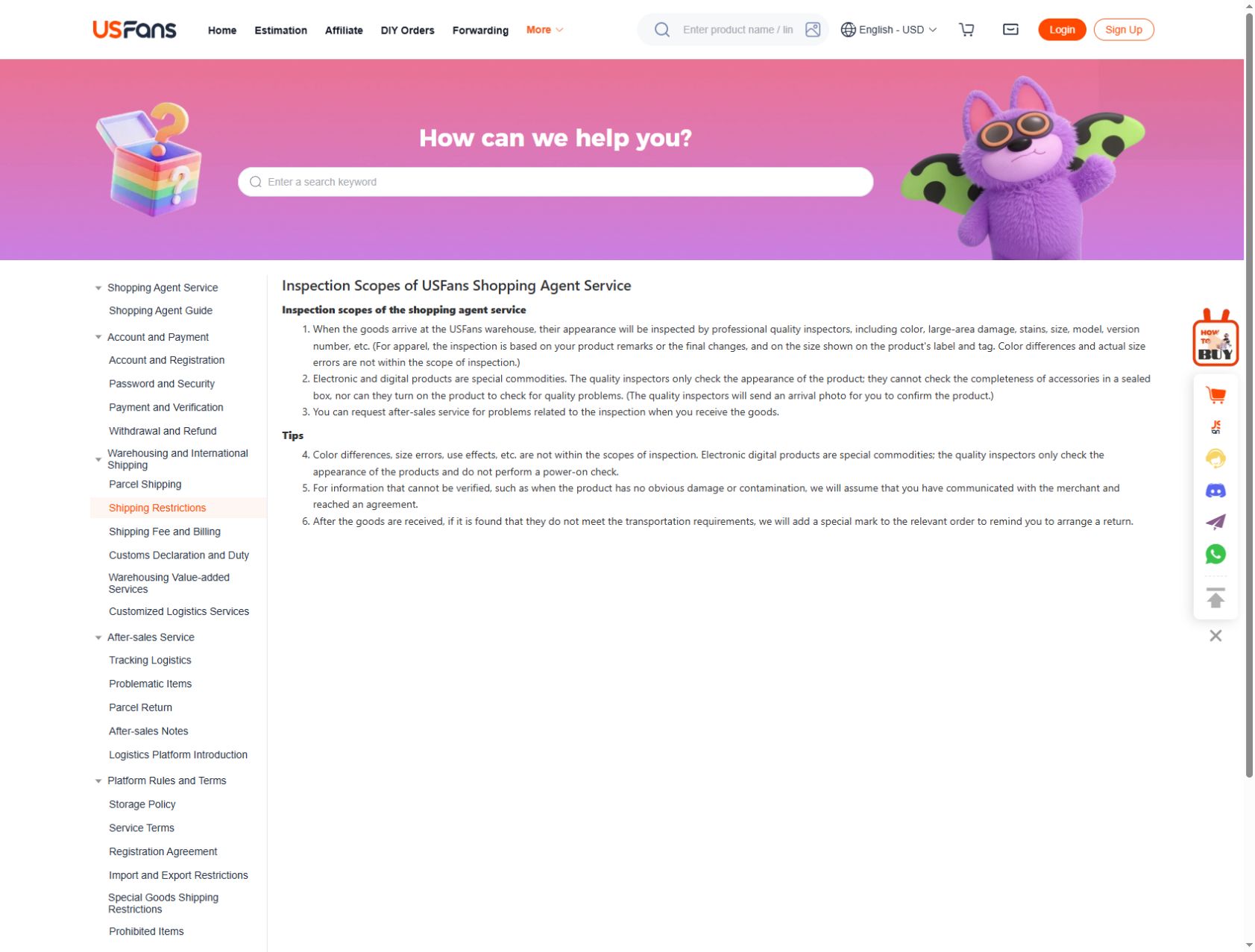
The inspection policy checked on 30 September 2026 covers appearance and clothing-label checks, but excludes actual-size differences and colour differences from that inspection. Electronics are not powered on and accessories inside sealed packaging are not checked for completeness. A label photo therefore does not answer a sleeve-measurement question, and a device photo does not establish a successful function test.
If an important detail is unclear, ask a precise question while the item is still at the warehouse. “Please confirm which order this photo belongs to” is different from “Please measure the garment.” Read the QC photo guide for choosing the question, and returns guidance before relying on a remedy. Do not assume every request or return will be available on the same terms.
Treat the parcel as a new calculation
Your shortlist's item weights are not automatically the final packed parcel weight. Packaging adds weight and volume. The USFans weight explanation checked on 30 September 2026 says some routes compare packed actual and volumetric weight and use the larger; the divisor depends on the logistics provider.
As a hypothetical calculation, a parcel measuring 40 × 30 × 25 cm has a volume of 30,000 cubic centimetres. Dividing by 6,000 gives 5 kg, while dividing by 5,000 gives 6 kg. If the packed parcel weighs 4 kg, those two formulas produce different potential billing weights. Neither calculation is a shipping price or a quote for your country.
Use the shipping calculator guide to interpret the inputs, then compare available routes against the actual parcel and destination. Consolidating items is not automatically cheaper: dimensions, restrictions and the alternative quotes matter. Check what is included in each quote before choosing on price alone.
Follow the shipment without losing the item record
Once a parcel has a tracking reference, retain the list of items inside it. Keep the purchase references separate so that a question about one garment does not become confused with a question about the whole shipment.
An electronic shipping reference does not by itself establish physical collection. Read the actual event text and the carrier information associated with the parcel. Our tracking guide and delivery-time guide explain how to separate events from estimates.
Questions before your first order
Does saving an item in a spreadsheet place an order?
No. A shortlist records interest. Confirm any purchase through the ordering account and its transaction record rather than through a spreadsheet row.
Can I work out the exact international charge from the product page?
A product page alone may not provide the final packaging dimensions, applicable route or destination-specific quote. Estimate before buying, then reassess when the parcel details are available.
Where should I start if I am unsure about trust?
Read the USFans spreadsheet review for how to assess the shopping information and the spreadsheet safety guide for account and transaction checks. Neither a useful collection nor a clear ordering sequence removes the need to assess the particular seller, item and shipment.
USFans Agent: Understand the Purchase Service Before Building a Parcel
Using a shopping agent introduces steps between choosing a product and receiving an international parcel. A spreadsheet helps you identify candidates; it does not place the order or settle the shipping proposal. Before committing, understand which part of the process you are paying for and what remains to be decided.
The USFans shopping-agent instructions checked on 30 September 2026 separate payment for products and domestic transport in China from later international parcel payment. Confirm whether the service can purchase your exact source and option before paying; the first amount does not cover the later shipment to your address.
Keep three roles distinct
The product offer describes the item and options. The shopping-agent process concerns purchasing and handling that selection. The transport proposal concerns getting the prepared parcel to its destination. A question about one role may need different information from a question about another.
For example, an item being listed does not establish that your preferred option can be purchased. A warehouse photograph does not establish which transport options accept the finished parcel. Keep each confirmation attached to the relevant stage rather than using one successful step as proof of the next.
Before submitting a product choice
Check the source reference, model, option, quantity and contents. If a picture shows several pieces, establish whether your selection covers the set or one component. Retain the details you intend to buy so that a later discrepancy can be described precisely.
You can inspect the jacket candidate on OG while considering a product. Its public listing is not a completed agent purchase or a quote for sending a jacket to you. Investigate the option before treating it as part of an order.
The individual-link guide distinguishes a source reference from a search result. The spreadsheet-links guide helps keep several candidates separate while you choose.
Budget for the stages you have not reached
Write down what each amount covers and its currency. Products, domestic transport, international shipment and any selected additional services should not become one unexplained total in your notes. Ask about the scope of an unclear charge before relying on it.
An early estimate is useful for deciding whether a purchase fits your budget, but it does not give the final dimensions of a future packed parcel. Revisit the proposal when the relevant parcel information exists. The shipping calculator guide explains the distinction between estimated inputs and a packed calculation.
If the purchase only makes sense below a particular delivered total, keep that constraint in view before buying additional goods. A low product price does not remove the later transport decision.
Warehouse inspection answers a bounded question
The inspection description checked on 30 September 2026 covers appearance and clothing-label information but excludes actual size and colour differences. Electronics are not powered on, and completeness of accessories inside sealed packaging is not checked. A size label is therefore not the same evidence as a garment measurement, and an arrival photo is not a functional test.
Choose the question you need answered. If sleeve length matters, specify the measurement; if a visible mark concerns you, identify its location. Ask about availability and cost before relying on an additional service. The QC guide helps match a request to the observation you need.
Do not conclude authenticity, long-term durability or suitability from a general inspection label. A clear-looking item can still have characteristics that photographs do not establish.
An example of the next decision changing
Imagine two items: one has arrived and its visible details meet your expectations; the other is still outstanding. This is a hypothetical planning example.
You might consider waiting, asking about the second item or investigating a proposal for the ready item. These are questions to resolve under the actual conditions, not a promise that every option will be available. Check storage terms and the consequences for the parcel before choosing.
Do not assume consolidation always saves money or that splitting a parcel means dividing one shipping price. Compare proposals for the contents you really intend to send. The shipping guide keeps those alternatives on a comparable basis.
Ask support about an action, not the whole account
Identify the item or parcel privately, state what its record shows, and ask what you need clarified. A question about changing an option differs from a question about payment or dispatch. Keep the previous answer with the follow-up so that the conversation remains tied to the same issue.
A response acknowledging a request does not establish that the change is complete. Verify the resulting record. If you want to return or change an item, check the conditions applicable to its current stage rather than assuming an outcome from another buyer's story. See support guidance and returns guidance.
Frequently asked questions
Is a product in a spreadsheet already approved for my parcel?
No. The collection identifies candidates. Purchase eligibility, selected options and transport conditions require their own checks.
Does using an agent mean the product has been tested?
Do not assume a test beyond the described inspection. Appearance, measurements and powered operation are different observations.
Does an earlier successful order settle the next one?
It gives you experience of that transaction. A new item, option or parcel still needs its own assessment. The review guide explains how to use experience without extending it beyond the case.
Where should I begin if I have not chosen anything yet?
Start with the USFans collection and the best-spreadsheet guide. Then use the ordering guide to connect a specific choice with the next stage rather than treating browsing as a purchase.