USFans Spreadsheet · Guides
USFans Shipping: Compare the Whole Parcel Proposal Before Choosing
Compare USFans packing decisions, delivery costs, route conditions and timing for the same parcel rather than relying on product prices or unrelated quotes.
Choosing USFans shipping is not just choosing the smallest price on a screen. The useful comparison is between proposals for the same goods, destination and packing arrangement, with the included services and timing clearly understood.
Begin before buying: decide whether the likely delivery commitment fits the purpose of the purchase. Revisit that decision when actual warehouse and parcel information becomes available. An attractive product price does not establish an attractive delivered purchase.
On this page
Keep purchase costs separate from delivery costs
USFans' shopping-agent instructions describe paying for goods and domestic shipping before the later international parcel stage. Keep those stages separate in your budget rather than assuming that the first payment covers the whole journey.
Record the amount, currency and meaning of each quoted charge. Optional services should be identified as selected or unselected, not silently included in one comparison and excluded from another. If a promotion appears to reduce a price, check the amount actually payable under its conditions.
The ordering guide connects those payments to the purchase and warehouse records. The shipping calculator guide explains why an early weight estimate can differ from the packed parcel calculation.
Decide what you are asking to ship
Confirm the included items and their options before approving packing. Resolve any concern that could make you return or exclude an item while the decision is still relevant. The QC guide helps you ask a specific question rather than treating every photograph as complete reassurance.
For a product candidate, inspect the jacket on OG. Its listing identifies something to investigate; it does not supply the dimensions or delivery price of a future packed order. Do not attach a generic parcel estimate to it as though the garment had already been weighed and packed for you.
Compare three possible packing decisions
Suppose you have two items at the warehouse and a third purchase still outstanding. You may be considering these alternatives:
| Proposal | Question to resolve |
|---|---|
| Wait and send all three together | Is the wait acceptable, and what storage terms apply to the earlier items? |
| Send the two ready items first | What would the separate parcel proposals cost and include? |
| Reconsider the outstanding item | What options are actually available at its purchase stage? |
This is a hypothetical decision framework, not a statement that all three options will be available in a particular account. Ask for the relevant conditions before relying on one.
Consolidation is not automatically the cheapest answer. A combined package can change its dimensions, and separate parcels can introduce separate charges. Compare actual proposals rather than adding product weights and predicting the result.
Identify the weight used in the quote
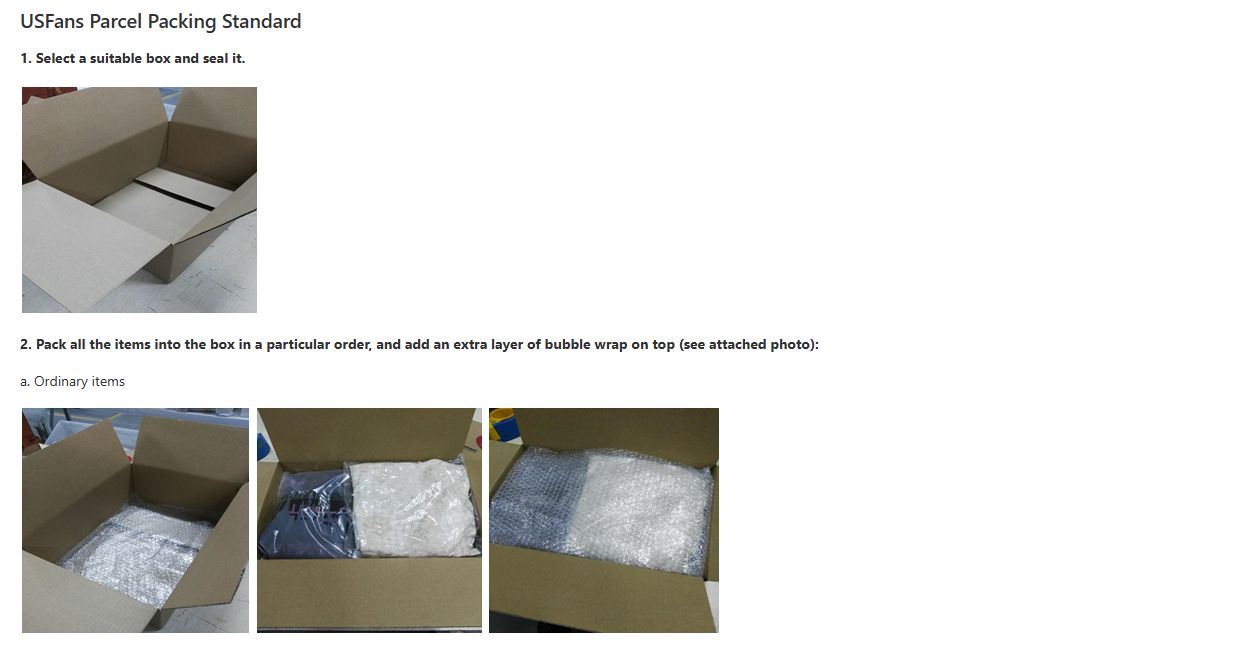
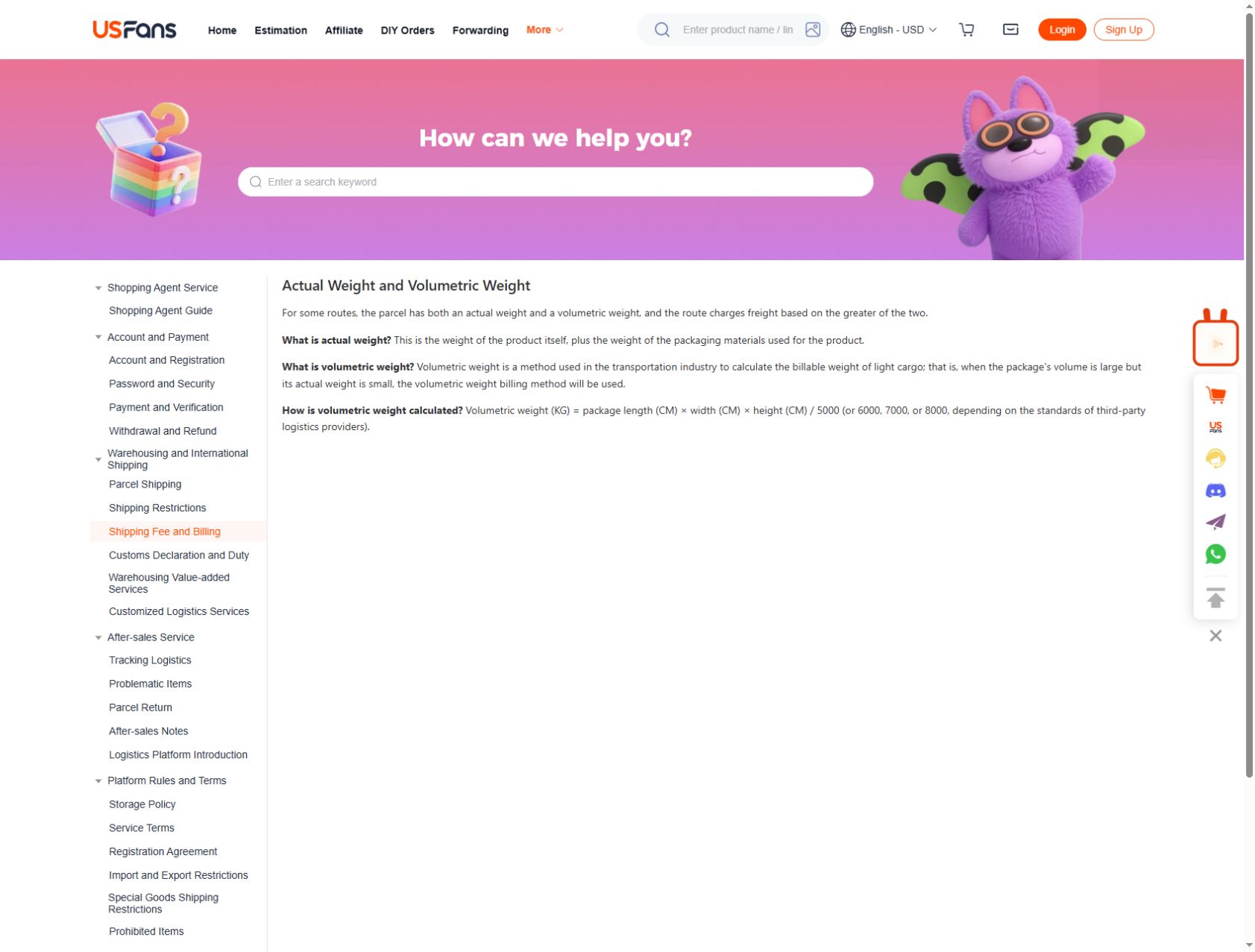
The USFans weight rules checked on 30 September 2026 distinguish actual packed weight from volumetric weight. Some services charge using the larger value; their volumetric divisor depends on the provider. Do not substitute the product-only weight or whichever divisor gives the lower result.
For the proposal you are comparing, keep the final outer dimensions, packed scale weight, applicable divisor and billing increments together. The calculator examples show the arithmetic. They do not supply a rate for your destination or prove that a route accepts the goods.
Check the route conditions against the contents
Use an accurate description of what will be shipped. If an item has features relevant to transport restrictions, resolve eligibility for the proposed route before choosing it. A route shown for another parcel is not evidence that it accepts yours.
Do not alter the description to force a result or assume that warehouse acceptance proves international transport eligibility. If the available options are unclear, ask about the specific contents and destination through support.
Keep the distinction between a technical calculation and an available service. You can calculate volumetric weight on paper without establishing that any particular route is offered for the parcel.
Rule out unsuitable proposals before comparing amounts
A comparison is easier when you first separate requirements from preferences. A required destination or an eligible item type is not the same kind of consideration as a preferred lower price. Use this worksheet with actual proposals; it does not name or endorse a USFans route.
Swipe sideways to compare all columns.
| Question | If the answer is no | If the answer is unclear |
|---|---|---|
| Does the proposal cover the intended destination? | It does not serve this shipment | Clarify the exact destination details |
| Are the actual contents eligible? | Do not choose it for those contents | Ask about the relevant item feature |
| Is the proposed packing acceptable for the goods? | Reconsider the packing proposal | Ask what protection is included |
| Do you understand the amount and exclusions? | Do not treat it as a complete cost comparison | Request the missing breakdown |
| Is the timing compatible with your purpose? | Reconsider a date-sensitive purchase | Clarify the estimate's starting point and scope |
Only then compare the alternatives that still meet your requirements. If two proposals use different packing, do not present them as a pure route-price comparison: you are comparing both a packing choice and a transport choice.
You may prefer a higher-priced proposal because its stated service fits your needs better, but write down the specific reason. A higher amount alone does not prove better protection, faster delivery or easier problem resolution. Likewise, a lower amount does not establish that important conditions are absent; read the actual proposal.
Read the timing statement with the price
Find the starting point of the quoted time window. Does it describe movement after dispatch, or include earlier preparation? Is it presented in working days or calendar days? Clarify ambiguous wording before using it to plan around an event.
The delivery-time guide explains these separate stages. A fast-looking estimate cannot guarantee a deadline if the product has not yet arrived at the warehouse or the estimate excludes preparation.
If your purchase only makes sense before a fixed date, treat that as a decision constraint. Do not resolve it by borrowing a successful delivery story from another buyer whose route, date and parcel differ.
Compare destination-specific proposals, not country stereotypes
For Poland, Spain, Latvia, Argentina or Mexico, the starting point is the destination actually accepted in the current quote, together with the parcel details and applicable conditions. A report about one country does not establish availability, cost or timing for another.
Keep the country and any required destination details consistent between alternatives. If you change them, refresh the proposal. A country name in a product spreadsheet is not confirmation that a specific shipping service is available there.
Where a quote describes handling of additional charges or optional protection, read exactly what is included and excluded. Do not infer an entitlement or a universal all-inclusive cost from a short route name. The insurance guide separates protection questions from ordinary transport estimates.
Review once more before approving
Use this short check on the final proposal:
- The item list matches what you intend to send.
- The destination details are correct.
- Packed weight and dimensions refer to this proposal.
- The price and selected services are understood.
- The route conditions apply to the actual contents.
- The delivery estimate's scope is clear enough for your decision.
If something changed since the earlier estimate, compare the inputs and ask about the difference before proceeding. Keep the confirmation privately with the parcel record. The tracking guide then concerns events after submission rather than the earlier choice of proposal.
Frequently asked questions
Why can a low-priced item still have substantial delivery costs?
The item price does not determine the packed parcel's dimensions, weight or available transport options. Review those inputs rather than judging the quote solely as a percentage of the goods' price.
Is a warehouse photo enough to choose a route?
No. It can help assess visible product details, but you still need the parcel and destination information relevant to the proposed service.
Can I use an old quote for a new parcel?
Use it only as a historical comparison. Refresh the proposal for the new contents, packing, destination and available conditions.
Where should I browse before starting an order?
Return to the USFans spreadsheet collection and keep candidates separate from confirmed purchases. The best-spreadsheet guide helps evaluate the usefulness of the collection itself.
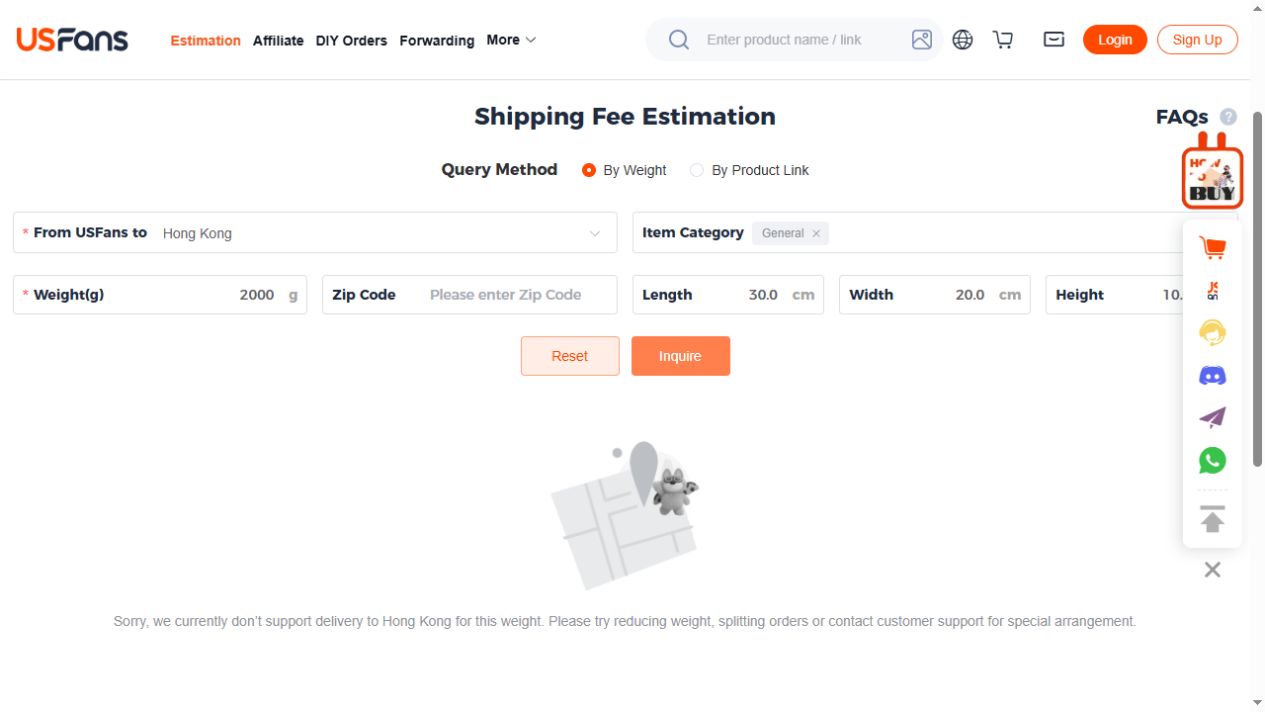
Does USFans ship to Hong Kong?
The public estimator returned no service for the following Hong Kong example on 1 October 2026.
| Input | Tested value |
|---|---|
| Contents | General clothing |
| Weight | 2,000 g |
| Size | 30 × 20 × 10 cm |
| Postal code | Not entered |
A selectable destination is not enough by itself: the returned service list matters. In this case it was empty, so no Hong Kong price or delivery interval can be taken from the example.
For destination-specific examples, see Mexico and Argentina in the Spanish shipping guide.