
USFans Spreadsheet · Guides
USFans Shipping Calculator: Why the Box Can Change the Estimate
Understand packed and volumetric weight, compare consistent USFans parcel inputs and explain estimate changes without mistaking example calculations for live prices.
A shipping estimate is only as useful as the parcel description behind it. Entering the weight of the goods without allowing for packaging can produce a different result from pricing the finished parcel. Dimensions can matter as much as weight on routes that use volumetric billing.
Use this guide to understand the calculation and compare quotes. The worked figures below are hypothetical weight calculations, not live USFans prices, available routes or delivery promises.
On this page
Start with one version of the parcel
Before comparing results, fix the destination, contents and packaging proposal. Keep the packed weight, length, width and height together. A quote for a different box or a different destination is a different proposal, even if it contains the same products.
If you have not bought the goods yet, label the inputs in your own notes as estimates. After warehouse arrival and packing, replace them with the information actually available for that parcel. Do not carry an early approximation into the final decision without checking what changed.
The USFans ordering guide explains the separate goods-purchase and international-shipment stages. A product purchase amount is not the same thing as the cost of sending the parcel to you.
Actual weight and volumetric weight answer different questions
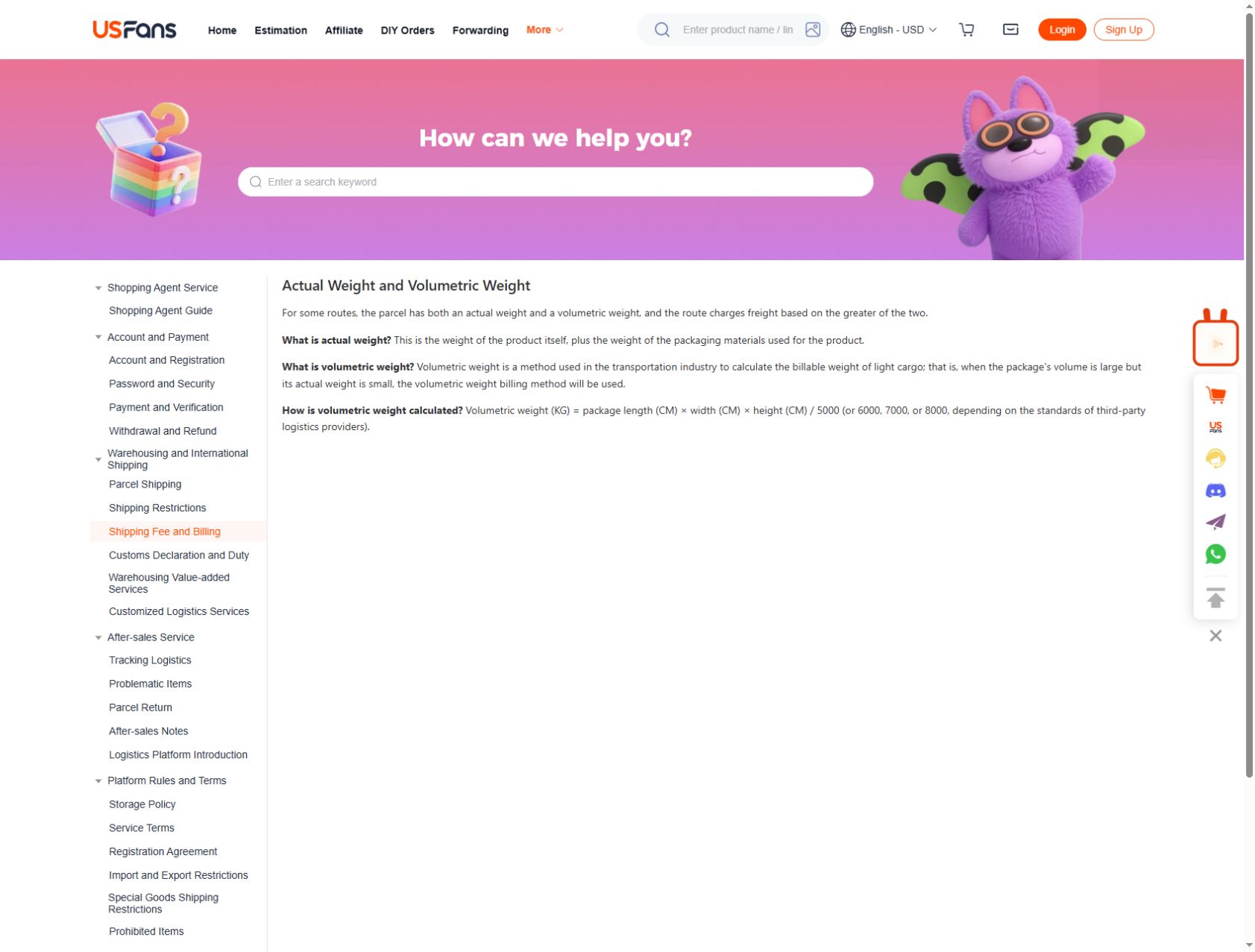
The USFans weight guidance checked on 30 September 2026 includes packaging in actual weight. Some routes charge on the greater of actual and volumetric weight. Its examples use divisors of 5,000, 6,000, 7,000 or 8,000 depending on the logistics provider; none should be treated as the rule for every service.
For dimensions in centimetres, the stated calculation is:
Volumetric weight in kilograms = length × width × height ÷ the applicable divisor.
Do not choose a divisor because it gives the most attractive answer. Use the rule belonging to the specific route being considered. Multiplying dimensions produces a volume, not a shipping charge; even the resulting weight still needs the route's pricing rules.
Worked example: reducing volume without changing the goods
Consider two hypothetical packaging proposals for the same goods:
Swipe sideways to compare all columns.
| Input | Proposal A | Proposal B |
|---|---|---|
| Packed dimensions | 45 × 35 × 30 cm | 45 × 35 × 20 cm |
| Packed actual weight | 5.2 kg | 5.0 kg |
| Volume | 47,250 cm³ | 31,500 cm³ |
| Volumetric weight using 6,000 | 7.875 kg | 5.25 kg |
| Larger of actual and volumetric weight | 7.875 kg | 5.25 kg |
Under that hypothetical rule, volume determines both results. The second proposal has a lower weight basis even though the actual weight changed only slightly.
Now use a divisor of 5,000 instead: the volumetric figures become 9.45 kg and 6.3 kg. That difference is why a divisor cannot be borrowed from another buyer's quote. These figures are before any route-specific rounding or minimum-charge rules and do not predict the amount payable.
Nor does the example mean packaging should always be reduced. Protection and the item's needs matter. Ask what a packing change would remove and whether it remains suitable before assuming that a smaller box is a better shipment.
Avoid using a product name as a shipping input
Inspect the Nike Elite black-and-pink backpack candidate on OG as an example of an item to investigate. Its name and product images do not provide the packed dimensions of a future order. Do not assign it the hypothetical measurements above.
The same distinction applies to shoes, clothing sets and accessories found through the USFans spreadsheet. Product information helps identify what you want; a parcel proposal tells you how the selected goods will travel.
Compare routes on the same basis
Once you have results for the same parcel, record enough detail to understand why they differ:
- Destination and the quotation date.
- The contents and any restrictions relevant to them.
- Actual weight, dimensions and the quoted chargeable-weight rule.
- The amount, currency and services included in the quote.
- The stated delivery estimate and which stage it describes.
- Any optional service you selected rather than assuming it is included.
Read additional charges and conditions directly from the proposal. A lower displayed amount is not automatically a lower complete cost if the compared services differ. A shorter time window is not a guaranteed arrival date.
Our delivery-time guide separates preparation and carrier movement. The shipping guide covers the wider decision once the calculation makes sense.
When the estimate changes
A comparison you can keep beside two quotes
Copy this small record into your own notes. Fill it from the two actual proposals rather than guessing fields that are absent.
Swipe sideways to compare all columns.
| Comparison field | Earlier proposal | Later proposal |
|---|---|---|
| Date and currency | Record both | Record both |
| Destination and contents | Record the inputs | Identify any change |
| Packed weight and dimensions | Record the full parcel | Record the full parcel |
| Billing rule and rounding | Record what the proposal says | Record what the proposal says |
| Route and selected services | Record the exact selection | Identify any change |
| Quoted amount and exclusions | Keep the stated scope | Keep the stated scope |
If you lack a field, ask about that field before attributing the difference to a particular cause. Do not fill an absent divisor with the example above or treat an omitted service as included.
For a purely hypothetical arithmetic example, suppose an earlier proposal totals 180 units of one currency: 160 for transport and 20 for a selected service. A later proposal totals 195: 175 for transport and the same 20 for that service. The total rose by 15, and the displayed transport component accounts for that difference. The arithmetic does not establish why transport changed: that requires comparing the parcel inputs and applicable rate. These invented amounts illustrate reconciliation, not USFans prices or its fee structure.
This distinction prevents two different questions from becoming confused: “Which component changed?” and “What caused that component to change?” A breakdown can answer the first while still leaving the second unresolved.
If the final amount differs from your earlier notes, compare the inputs before looking for a single explanation. Check whether packaging increased the weight or volume, the destination changed, a different route was selected or an additional service was included.
Keep a clear earlier-and-later comparison in your private records. Ask which changed input accounts for the difference. Avoid assuming that every increase has the same cause, or that removing one item will reduce the charge by its individual weight.
If you are considering splitting or combining parcels, request comparable proposals for the alternatives. Adding two item weights is not enough to predict their separate packed dimensions or the combined shipping total. Neither consolidation nor splitting is automatically cheaper.
What to do when no route appears
An empty result does not establish free shipping, a website-wide outage or permanent unavailability. Recheck the entered units, destination and parcel details, then ask about the specific proposal through the appropriate support channel.
Do not change the description of the contents just to make a result appear. The quote must correspond to what will actually be shipped. Keep unresolved route eligibility separate from a calculation error.
Frequently asked questions
Does volumetric weight replace actual weight on every route?
No. The platform's guidance describes this comparison for some routes. Read the rule for the option you are considering instead of applying it universally.
Can I use someone else's parcel screenshot to estimate mine?
It can illustrate how a quote is presented. Its price only describes that case and its inputs; it is not a current quote for your destination and parcel.
Why does a lightweight item sometimes make the estimate larger?
It may change the necessary packaging dimensions. Check the revised proposal rather than assuming that only the added item's scale weight matters.
Is this page a live calculator?
This is a calculation guide. Confirm available routes and the current amount in the quote associated with your own parcel before approving shipment.